

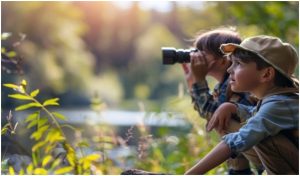
The Crested Serpent Eagle was the first bird our guide pointed out as we began a two-hour walk in the Anamalai Hills. Its ornithological name is (Spilornis cheela), and it’s a prominent raptor in the Valparai regions of the Western Ghats, where I had the pleasure of spending a few days last week.
The combination of the eagle and serpent is one of the oldest spiritual archetypes in the world, carrying deep meaning across multiple traditions. While there are many interpretations, the one that appeals to me is that, rather than depicting a battle, the eagle and the serpent represent wholeness. In this light, the serpent eagle symbolises the healing power of embracing both sides of my nature.
Our next sighting was the Malabar whistling thrush, better known as the whistling schoolboy for the whistling calls that they make at dawn. The first night at Sina Dorai Bungalow, our hosts told us that we might hear someone whistling and that it was not a prank to wake us up early in the morning. True to form, at the crack of dawn, the whistles started. I stepped onto the veranda of our bungalow to see a blue and black bird. Not knowing what it was, but eager to begin my morning of bird watching, I whipped out my phone and got a few photographs of it on the driveway. This black beauty, I later learnt, was the whistling schoolboy.
Reading more about the whistling thrush, I learnt it’s seen as a spiritual messenger bridging the physical and spiritual realms. The melody of its song is supposed to bring messages of comfort and continued connection to loved ones who have passed. I would like to think my early morning encounter with this beauty who came to my doorstep was a message from another realm.
Our third sighting was the long-tailed shrike, also known as the Rufous-backed Shrike. It feeds on a wide variety of large insects, fish, lizards, amphibians, and any small living animal that can be caught. On further reading, I learnt it’s commonly referred to as the butcher bird of India because it impales its prey on a sharp thorn. They apparently don’t have strong claws, so this technique allows them to use their hooked beak and eat their catch. The distinctive black mask across its eyes and forehead makes the shrike stand out, but not as much as the nickname ‘butcher bird’.
A bonus gift from our bird watching trip was seeing the striped-necked brown mongoose (Urva vitticollis). It is the largest mongoose found in Asia, and is easily recognized by the prominent black stripe, which accounts for its name. Spotting this resilient animal is a highly positive omen in South Asian folklore. Whether it brings you financial success or simply clears away bad energy, seeing one is widely seen as a fortunate event!
Seeing a streak-throated woodpecker, a rufous Treepie, a few jungle fowls, a pair of spotted doves, and an orange minivet were other gifts from our morning walk.
The one common thread that connects all these lovely creatures is the stories that we humans create to try to make meaning in our lives. The ability to document, chronicle, and share our experience is what separates us from other species. The butcher bird, the good omen, the clearer of bad energy, or the messenger from another realm are some of the stories that will stay with me as memories from my trip to the Anamalai hills.
The stories we tell each other and the stories we tell ourselves often intersect. “If you spot it, you got it” is a reminder that I can only see in others something I carry within myself. Self-awareness, the inner search for my true self and going out in search for birds have some things in common. Silence and the sound of birdsong. Both offer the space to find oneself and act as a portal to the soul. The birds seem to be calling me – Maybe this is the beginning of me finding my way into the wonderful world of birding, or maybe it was just a walk in the wilderness that inspired me.
PS. I learnt the meaning of a new word. Rufous is an adjective that means reddish, brownish-red, or rusty. Derived from the Latin word rūfus (meaning red). It describes a warm, earthy hue resembling oxidized iron or rust. The last time I wrote about the rufous treepie, (https://www.linkedin.com/pulse/secret-rufous-treepie-nikhil-dey.) I had no idea about the meaning of the word.
_________________________________________________________________________________________
The views and opinions published here belong to the author and do not necessarily reflect the views and opinions of the publisher.