


Many brands suffer from being remembered incorrectly. This is one of the most interesting problems in communication today. A company may have matured and transformed, but the market may still be carrying an older version of it. In most cases people remember what a brand first meant to them and that memory doesn’t refresh automatically. This is also called a reputation-lag.
Inside the company, the change feels obvious. New leaders join, better clients are onboarded and even the product improves. Outside, on the contrary the perception changes slowly. The market still sees yesterday’s company with today’s logo. This is where communication becomes a serious business function. It helps the world update its understanding.
We still remember Nokia as the toughest feature mobile phone. In quiz contests in schools IBM is still known for its legacy machines and putting a man on moon but it is lesser known now for the technology its solving for governments and organizations. Beyond bulbs and appliances, it’s lesser known that Philips is a health technology company across diagnostics and healthcare informatics. Adobe today has expanded from creativity tools to marketing infrastructure, but memory often remains with designers. Paytm too which is a digital financial enabler with features of wealth management is remembered for UPI transactions only.
Over the years, technology has made the customer journey easier to execute. The full-funnel from awareness, experience, purchase and behaviour can be created and tracked with dashboards and tools. We however are still unable to answer a different reputation question: how does someone move from ‘noticing us’ to ‘trusting our role in the world’?
As I moved across startups, emerging companies, unicorns, GCCs, another pattern began to appear. The purchase journey was being mapped with great precision, but the reputation journey was still being discussed in fragments. A young company would ask for visibility when it actually needed legitimacy – Zappfresh when it started. A fast-growing company would celebrate scale when the market was still looking for consistency – Zepto these days. A unicorn would speak of ambition when stakeholders wanted maturity – apna when it received its second funding. A GCC would have deep enterprise value inside the organisation, but very little external articulation of its real contribution – Micron, for the semiconductor problem it is solving.
What I felt was missing was a consolidated way to map the relationship between a brand’s stage, its communication requirement and the reputation outcome it should be building. I wanted to put together a clearer map for reputation progression. This is the psyche behind the Prominence Lifecycle Communication Framework. It gives communication leaders a way to locate the brand honestly, identify the reputation task in front of it, and align messaging with proof. The goal is to match the organisation to what the world believes about it. Rather than treating reputation as an abstract concept, this framework provides a clear, stage-by-stage roadmap from mere presence to enduring market authority.
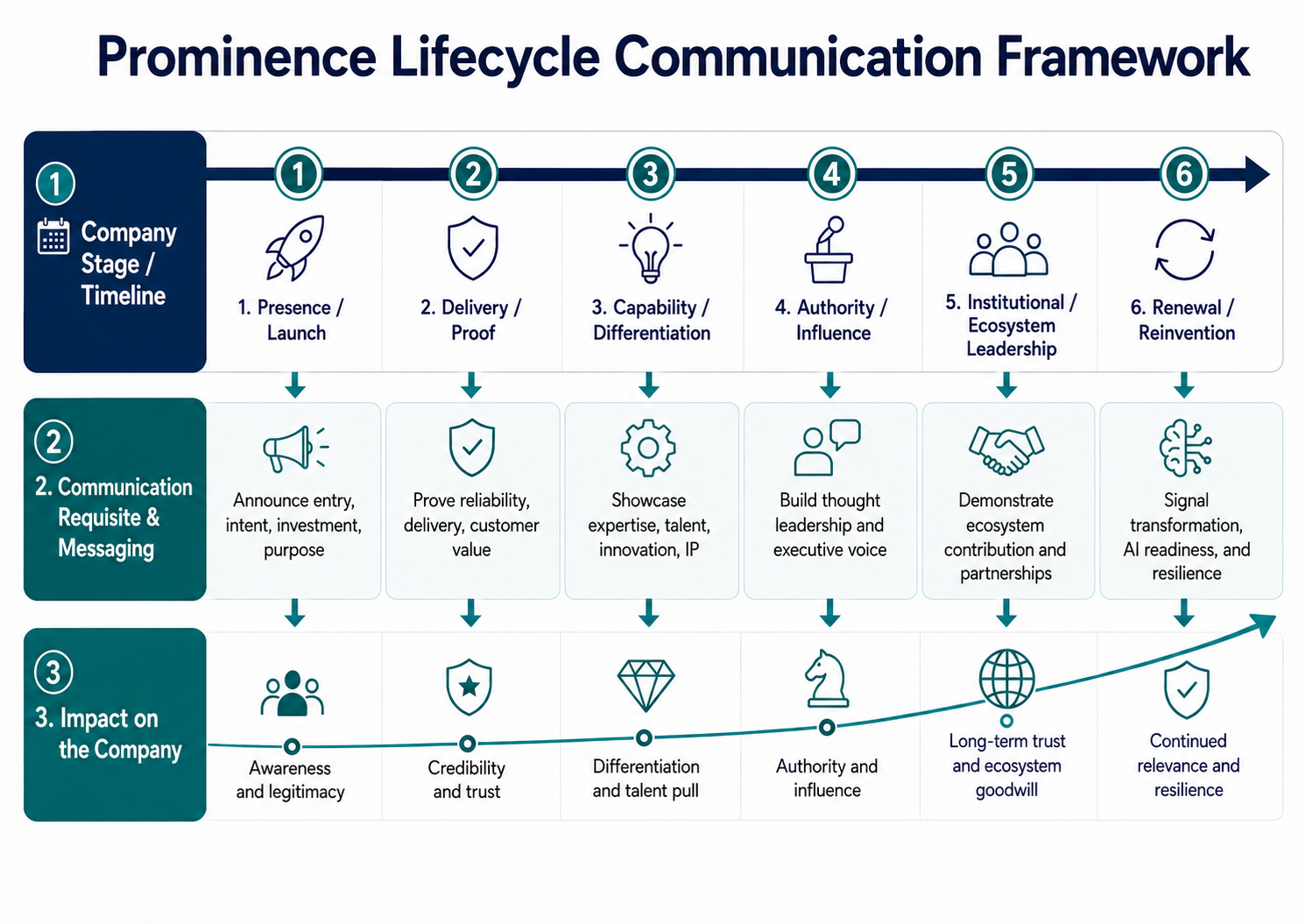
A launch-stage company naturally needs to generate basic awareness, answering foundational questions about its intent and purpose → The audience then demands proof of delivery, expecting the brand to demonstrate execution quality and customer success → Once a brand proves it can deliver, it must intelligently pivot to showcasing differentiated capability → The narrative must elevate to authority, where leadership voices shape category decisions and influence industry thinking. Ultimately, this leads to institutional leadership ensuring the brand remains resilient and future-ready.
Global Capability Centers (GCCs) in India are a perfect example and they too are a catalyst for this Communication Framework. Many of these third campuses have decentralized to an ownership stage. They now provide strategy and capability advantages to their headquarters. While they influence products, AI adoption, customer experience, and even global decision-making, their reputation often remains ambiguous and trapped. The company will be popular globally, the local talent applying here first searches what the company is into. This itself is a sheer opportunity lost where there’s no brand recall. That gap is not cosmetic to be ignored. It affects talent and leadership access, stakeholder confidence and ecosystem influence at a macro-level.
When a brand is under-articulated, its value gets discounted. When it is over-claimed, its trust gets questioned. The art is in knowing when and what the brand has truly earned the right to say.
Access to the Prominence Lifecycle Communication Framework.
__________________________________________________________________________________
The views and opinions published here belong to the author and do not necessarily reflect the views and opinions of the publisher.