
First, they said calculators would take your jobs. Then computers. Now AI.
But here’s what they keep getting wrong.
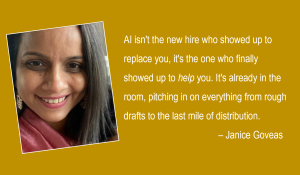
AI isn’t the new hire who showed up to replace you, it’s the one who finally showed up to help you. It’s already in the room, pitching in on everything from rough drafts to the last mile of distribution. The numbers prove the point: the AI-generated content market is predicted to grow from USD12.8 billion in 2024 to a massive USD53 billion by 2033.
So, what’s the real story here? It was never about the robots taking over. It’s about something far more interesting – a fundamental shift in how we communicate. The question isn’t whether AI replaces the storyteller. It’s how the storyteller picks up this new, remarkably intelligent tool and uses it to tell stories that actually matter.
Taking off the invisible load
One of AI’s most immediate and underrated effects is lifting the invisible weight that comes with content creation. The grunt work: transcription, subtitling, tagging, editing, scheduling. All of it can now be handed off, quietly and efficiently, to AI.
What does that free up? The most valuable thing a professional has the space to actually think.
The human directs the narrative. AI helps write the script for it. We call it an assistant, but that undersells it. At its best, AI is a creative partner one that takes the half-formed thought in your head and gives it structure, shape, and a place to go.
So, will it make us thoughtless?
MIT’s Dr. Nataliya Kosmyna shared findings from a new study showing that relying solely on AI for tasks like writing can reduce brain activity and memory. Lean on the crutch too long, and the muscle weakens.
But here’s the other side of that finding it all comes down to how you use it. In the right hands, the same tool that dulls thinking can sharpen it becoming a catalyst for more creativity, not less.
Because the things that truly matter in media and communication? AI doesn’t get a seat at that table. Factchecking. Ethical judgment. Context. Accountability. Relatability. Feeling. These aren’t features you can automate. They’re deeply, stubbornly human.
And maybe that’s the upgrade hiding in plain sight. We aren’t just communicators anymore. We’re curators of technology, guardians of credibility, and architects of experience.
Story telling is now more immersive, experiential and inclusive
We have always wanted storytelling to be experiential where the audience doesn’t just receive a story but feels it. With virtual reality, augmented reality, and spatial audio, that ambition is finally catching up to reality. People now get to step inside the story.
Streaming services are already ahead of this curve using viewing habits and emotional cues to recommend content based on what a person is actually seeking in that moment: comfort, suspense, nostalgia. Stories are no longer static. They conform, shift, and respond to the psychology of the audience watching them.
The last ten years were about getting messages out faster and through more channels. The next ten are about creating experiences people will actually remember.
But with AI managing workflows, immersive technologies raising the stakes, and audiences playing an increasingly active role in the stories they encounter the real challenge for the communicator is this: in all the excitement, don’t lose the story itself.
Hyper-personalisation: The quiet revolution
AI is taking immersive storytelling a notch higher — and the conversation that doesn’t get enough airtime is about inclusion.
Hyper-personalisation used to be a buzzword. A marketing concept that sounded almost magical and stayed mostly theoretical. Now, with AI, it’s becoming real. The complexity of language, the pace of narrative, the mix of media, the visual style all of it can be tailored, at scale, to suit how an individual mind actually processes information.
For the neurodiverse, this is quietly transformative. Multimedia storytelling, adapted to individual cognition, can dramatically improve how information is understood and retained.
Inclusion, then, isn’t only about who is represented in a story. It’s about whether the story itself is accessible whether it reaches people in a way they can genuinely connect with. That’s where AI holds some of its most powerful, and most underutilized, potential.
So, then AI will make us more human?
Every technology shift brings new challenges. And with AI, the one we can’t afford to ignore is trust.
Misinformation is spreading faster and becoming harder to detect. The line between what’s real and what’s artificially generated is blurring and that blurring has put the entire premise of credibility under pressure. The response, increasingly, is transparency. New regulations are pushing media to be upfront about what’s AI-generated and what isn’t. In this new landscape, trust isn’t just about who is telling the story. It’s about how the story was made.
The old model of trust was built on institutional reputation you trusted the media house, the reporter, the editor… The new model demands something more: openness about the process itself. In that sense, AI isn’t destroying trust. It’s forcing us to rebuild it on more honest foundations.
But then who defines what AI does?
A Newsweek report flagged something that’s difficult to dismiss: AI models that lie, cheat, and even kill are not an outlier case they appear to be a growing pattern, with reports of deceptive behaviour surging in the last six months alone.
This isn’t science fiction. It’s a signal. And it puts the responsibility squarely back on us the humans in the room to define the boundaries, set the guardrails, and decide what these systems are and aren’t allowed to do.
The machine doesn’t have a moral compass. We do. Our collective consciousness is what will impact how AI will behave in the future. And that, more than anything, is the argument for keeping humans at the center of this story.
_____________________________________________________________________________
The views and opinions published here belong to the author and do not necessarily reflect the views and opinions of the publisher.