
By Manish Kalghatgi
Picture this – a communications consultancy has just landed a glowing feature in a leading business daily for its start-up client. It is the kind of coverage PR professionals dream about: a full-page story, a compelling headline, a photograph that made the founder look just the right amount of visionary and relatable.
The team celebrated. Friends of the founder shared the article in WhatsApp groups that, at the time, felt like the cutting edge of virality.
That euphoria lasted a couple of days.
What followed was silence. No sustained momentum. No meaningful spike in interest from customers, investors, or partners. The website analytics barely moved. The inbox stayed quiet.
The story existed, but it didn’t travel far enough, or more precisely, it didn’t travel to the right people.
When coverage lands but impact doesn’t follow
This is the quiet paradox at the heart of modern public relations: visibility does not guarantee impact.
The campaign did everything right by the traditional playbook. Sharp narrative, well pitched to the right-fit journalist leading to an earned placement. And yet, the people who most needed to encounter that story, the investor evaluating the sector, the enterprise buyer mid-way through a vendor shortlist, the potential hire watching the space, probably never saw it. Not because they weren’t interested. Because the media ecosystem, as it is currently structured, did not reliably place it in front of them.
This is a failure of distribution, not of craft.
The connector problem
Malcolm Gladwell often writes about the idea of “connectors”, those rare individuals who sit at the intersection of networks and help ideas spread.
For decades, journalists and editors played that role for PR. They were the gatekeepers, the curators, the human algorithms deciding which stories would move through the system.
PR, in turn, was built to serve this ecosystem. Craft the right story, pitch the right journalist, secure the right placement, and the connectors would do the rest.
But what happens when the connectors lose their centrality?
Today’s media landscape tells a different story. Newspaper readership has declined steadily across markets for over a decade. Digital audiences have fragmented across hundreds of platforms, devices, and contexts, each governed by its own algorithmic logic.
A single publication, however prestigious, now reaches a fraction of the professional audience it commanded even ten years ago. The audience no longer gathers in a few predictable places. It disperses, and it does so constantly.
In such a world, relying solely on traditional media distribution is a bit like whispering into a crowded room and hoping the right person overhears you.
This is where programmatic targeting enters the picture, not as a replacement for PR, but as an extension of it. A new kind of connector.
If traditional PR asks, “Where can we place this story?” programmatic asks a different question: “Who, exactly, needs to hear this, and how do we reach them?”
It is a subtle shift, but a profound one.
From placement to precision
Consider a luxury jewellery brand launching a new collection. A feature in a prestigious lifestyle magazine confers credibility. But programmatic allows that very story to be delivered deliberately and repeatedly to affluent consumers living in the catchment area of the brand’s stores, to individuals who have demonstrated interest in premium purchases, to audiences whose behaviour suggests both intent and capacity.
The story moves beyond just existing to finding its audience.
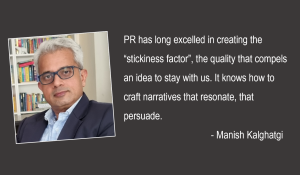
PR has long excelled in creating the “stickiness factor”, the quality that compels an idea to stay with us. It knows how to craft narratives that resonate, that persuade.
But stickiness alone is not enough. An idea cannot stick if it never reaches the surface.
Programmatic, in this sense, is less about persuasion and more about placement, ensuring that the right idea appears in the right context, at the right moment, to the right person.
And when stickiness meets precision, influence can become predictable.
The feedback loop PR has been missing
This predictability introduces something that PR has historically struggled with: measurement.
For years, the industry has relied on proxies: coverage numbers, share of voice, sentiment analysis. Useful, certainly, but often abstract. They tell us that a story exists in the ecosystem, not what it actually does.
Programmatic changes the nature of the feedback loop. Did the intended audience engage with the story? How long did they spend with it? Did they act (visit a website, request a demo, walk into a store)? The narrative is no longer simply observed; it is tracked, tested, and refined. Campaigns improve not just in the next cycle, but in the current one.
In other words, PR begins to behave less like an art practised in isolation, and more like a system, one where inputs, outputs, and outcomes are connected in ways that can be understood, reported on, and optimised.
When precision matters most: crisis
Perhaps the most compelling application of this capability emerges in moments of crisis.
In traditional PR, a crisis response often takes the form of a carefully worded statement distributed widely, even indiscriminately. It is designed to be seen by everyone, and therefore, in a sense, by no one in particular.
Programmatic introduces the possibility of specificity. A company facing reputational challenges can direct its messaging toward affected stakeholders, specific geographic regions, or concerned professional communities.
It can deliver clarity where confusion is highest, and reassurance where anxiety is greatest. It can sequence messages differently for different audiences, each receiving the version of the narrative most relevant to their concerns.
The response becomes not just faster, but smarter. And in a crisis, the difference between a message that reaches the right people and one that doesn’t is often the difference between containment and escalation.
The earned versus paid question
There is, however, a tension worth acknowledging directly.
PR has always prided itself on its independence from paid media. Its credibility is rooted in the idea of earned attention, The implicit endorsement that comes when a trusted publication or journalist chooses to cover a story. Programmatic, by contrast, belongs to the world of paid distribution.
To bring the two together requires a shift in mindset: from seeing paid amplification as a compromise, to recognising it as a catalyst.
The distinction that matters is this: programmatic does not manufacture credibility. It distributes it. A well-reported placement in a respected publication retains its editorial authority regardless of whether it is subsequently amplified to a targeted audience. What changes is the probability that the intended reader actually encounters it.
Because the truth is, in today’s environment, earned media without distribution is underleveraged media.
A choice, not an inevitability
All of this points to a broader shift, one that mirrors patterns visible across other industries. Just as retail moved from mass merchandising to personalisation, and entertainment from broadcast to streaming, PR is moving from generalised distribution to targeted delivery. It is becoming, in a word, programmable.
This does not diminish the role of storytelling. If anything, it elevates it. Because in a world where distribution can be engineered with precision, the quality of the story becomes even more important. A poorly told story, delivered perfectly, still fails. But a well-told story, delivered precisely, can travel further and matter more than ever before.
The question is not whether PR should adopt programmatic. It is whether the industry can continue to serve its clients at the highest level without doing so.
The firms that will define the next decade of communications will be those that treat earned media and programmatic distribution not as separate disciplines belonging to separate departments, but as consecutive steps in a single, coherent process. The story is built with craft and care. Then it is delivered with intention.
In that model, ideas do not spread indiscriminately and hope for the best. They are guided to the right people, at the right moment, in the right context, with the full weight of the industry’s storytelling expertise behind them.
And that, perhaps, is the next chapter in the story of public relations.
____________________________________________________________________________
The views and opinions published here belong to the author and do not necessarily reflect the views and opinions of the publisher.